
Trial Mania: Motorcycle Games
hikBOO StudiosRacing
4.3126.00 Reviews
- Version
- 0.2.42
- Installs
- 5.00M
- Age Rating
- Everyone
Screenshots
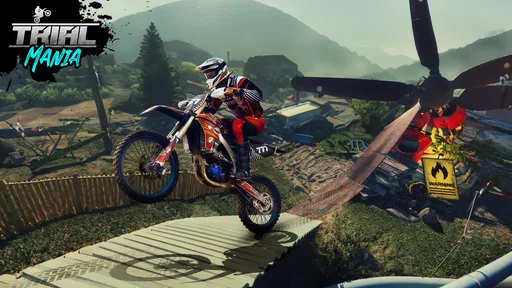
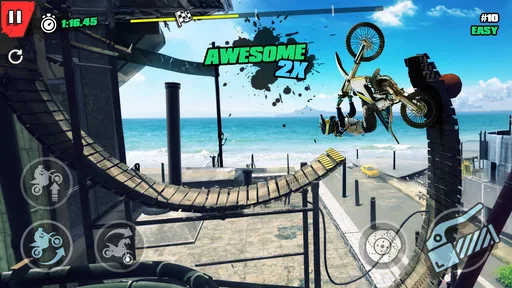
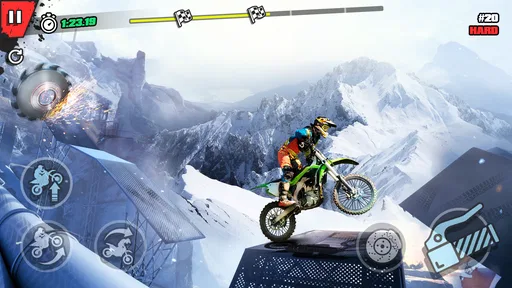
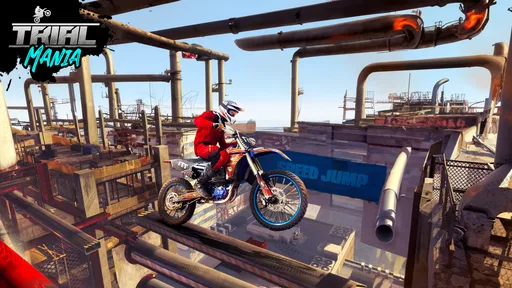
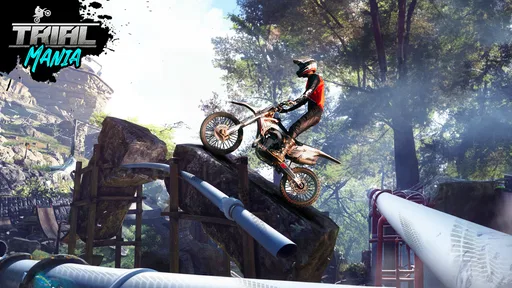
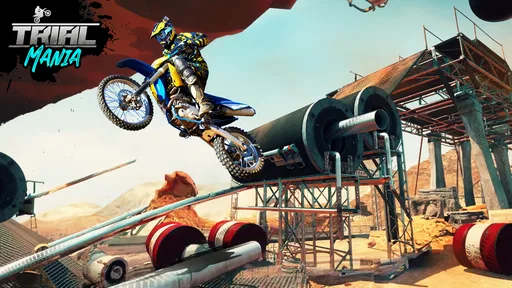
Our Review of Trial Mania: Motorcycle Games
 Analysis by Appyee
Trial Mania: Motorcycle Games is the kind of racing game I reach for when I want a quick burst of concentration rather than a long, polished campaign. Its focus is simple: control a motorcycle through trial-style courses, manage balance and momentum, and try again when a small mistake sends the rider tumbling. I found that straightforward idea more engaging than the short store summary suggests, especially when I played in brief sessions and treated each attempt as a chance to improve one specific section.
My overall view is positive but measured. This is a free game from hikBOO Studios, available for players aged Everyone, and it has grown to over five million installs with a 4.3 average from around six thousand ratings. Those figures suggest that its compact motorcycle challenges have found a sizable audience, but they do not change the central question: do you enjoy repeating a difficult obstacle until your timing improves? If you do, this is an easy game to recommend. If you want realistic racing, a large selection of licensed bikes, or a deep career mode, you may find it too focused and too minimal.
Why the riding feels more thoughtful than ordinary arcade racing
The biggest strength is the way the game turns movement into a problem to solve. In a conventional racing game, the main goal is usually to take corners quickly and overtake opponents. Here, the important decisions happen around slopes, jumps, landings, and uneven surfaces. I often found myself slowing down before an obstacle, not because I wanted to lose time, but because a faster approach would make the landing harder to control.
That creates a useful rhythm. I make an attempt, notice whether the front wheel or rear wheel caused the problem, and adjust the next run. The improvement is personal rather than purely numerical: I begin to recognize where a gentle input is safer than a dramatic correction. The most satisfying part is learning the course through small changes instead of simply holding the accelerator.
The game also works well as an offline activity. That matters in practical situations. I can imagine opening it during a commute with unreliable reception, while waiting for an appointment, or during a short break when I do not want to commit to a multiplayer match. It is built around self-contained attempts, so a session can end after one successful run or continue for much longer if I am determined to clean up a difficult section.
That short-session design is one of the reasons I think the game suits phones better than many larger racing titles. It does not ask me to remember a complicated storyline or manage a broad collection before I can have fun. I can start riding quickly, make a mistake, and restart with a clear idea of what I want to change.
Controls reward restraint more than frantic movement
Trial riding looks easy until the bike leaves the ground. On a flat stretch, basic acceleration feels natural, but jumps expose whether I have approached with the right speed and whether I am keeping the motorcycle stable. I learned to treat each jump as two separate tasks: first set up the launch, then prepare for the landing. Trying to correct everything at once usually made the bike less stable.
My most useful habit was to stop chasing speed when the motorcycle was already in a good position. That sounds obvious, but arcade racing encourages constant input. In this game, extra movement can turn a safe landing into a crash. When a section repeatedly caused trouble, I focused on arriving at the obstacle in the same way each time. Consistency made the next adjustment easier to judge.
This gives the game a modest learning curve without making it feel like a technical simulator. I never needed specialist knowledge about motorcycles. I only needed to pay attention to the relationship between speed, angle, and balance. That makes it approachable for casual players while still giving more patient players a reason to keep practicing.
What makes repeated attempts worthwhile
Retrying a course can become boring if every failure feels random. My experience was better when I could connect the mistake to a decision. A wheel landing too heavily on one side, a jump taken with too much speed, or a late correction all gave me something specific to change. That sense of cause and effect is more important here than visual spectacle.
I recommend using the first few attempts as observation runs rather than trying to set a perfect time immediately. Watch where the motorcycle becomes unstable, identify the obstacle that actually ends the run, and then concentrate on that point. Once it becomes reliable, the earlier parts of the course usually feel less stressful. This approach is especially helpful on a phone, where overreacting to a small mistake can be more common than on a controller.
Another practical tip is to avoid playing every attempt at maximum speed. A slower, repeatable run teaches more than a fast crash, particularly when learning the shape of a new course. After I understood the route, I could start looking for quicker approaches. That two-stage workflow—stability first, speed second—is the best way I found to make progress without turning the game into frustration.
The useful trade-off between simplicity and depth
Trial Mania benefits from not overwhelming the player. I can understand its basic appeal almost immediately, and the game does not require a long explanation before the riding begins. That simplicity is a genuine advantage for younger players and for anyone who wants a casual racing game rather than a hobby that demands daily management.
At the same time, simplicity limits the experience. Players who expect extensive customization, a detailed garage, realistic vehicle handling, or competitive online racing should adjust their expectations. The appeal is concentrated in the act of clearing motorcycle obstacles. If that central loop does not hold your attention, there is not much surrounding it to compensate.
This is where it differs from more conventional mobile racers. Those games often emphasize traffic, overtaking, visual speed, or vehicle collecting. Trial Mania is closer to a sequence of physical puzzles presented as motorcycle racing. I prefer it when I want control and timing to matter more than the size of the vehicle roster. I would choose another racing game when my mood calls for long races, dramatic competition, or a broader progression system.
The friction points that affect the recommendation
The main limitation is repetition. The same retry-based structure that makes a successful landing satisfying can make a failed attempt feel tiring when I am not in the mood to concentrate. A player looking for a relaxing ride may be surprised by how quickly a small error ends a run. The game is casual in length, but not always casual in attention.
There is also a difference between being free to install and being completely free of spending pressure. The game is free, with in-app purchases ranging from $0.99 to $15.99 per item. I would keep that in mind before handing it to a child, even though the content rating is Everyone. The safest approach is to use the device’s purchase controls and decide in advance whether optional spending is appropriate for the person playing.
I also think the game’s compact presentation may feel limited beside premium racing experiences. A larger alternative may offer richer environments, more elaborate sound, or a stronger sense of progression. Those additions can be worthwhile if you want a game that feels like a long-term collection. Here, the attraction is more immediate and mechanical: start a run, solve the obstacle, and try to improve.
Device compatibility is fairly broad for an Android game, since it requires Android 7.0 or newer. The current version is 0.2.42, so I would check that the phone meets the operating-system requirement before trying to install it. For someone using an older device, that requirement is worth checking first; for most compatible players, the more important consideration is whether the trial format matches their taste.
Who will get the most from it
I would recommend this game to players who enjoy retrying a tricky section until their hands understand the timing. It is a good fit for someone who likes short challenges, offline play, and racing games where finishing cleanly can matter more than simply going fast. It may also suit families looking for an accessible motorcycle game, provided an adult manages purchase settings where necessary.
It is particularly useful for small gaps in the day. Imagine waiting for a train that is delayed: I can play a few attempts, focus on one troublesome jump, and close the game without losing the whole evening. The same works during a lunch break or while waiting for a friend. The game’s structure makes it easy to stop after a short session, although a difficult course can also tempt me into “one more try” for longer than planned.
I would be less likely to recommend it to someone who dislikes failure loops. If a crash followed by an immediate retry feels like wasted time rather than useful practice, the central design may become irritating. It is also not my first choice for players who want head-to-head competition, realistic motorcycle simulation, or a large story-driven campaign. A conventional racing title would be a better match for those priorities.
How I would approach the game as a new player
I would begin with the sound and visual distractions kept low enough that I could concentrate on the bike’s movement. Rather than rushing through every course, I would identify the first obstacle that consistently causes trouble. Then I would repeat the approach with one change at a time: less speed, a different launch angle, or a gentler correction during the jump.
When a run fails, I would avoid immediately blaming the final landing. Often the real problem begins earlier, when the motorcycle approaches an obstacle too quickly or arrives at the wrong angle. Tracing the mistake backward is more productive than reacting only to the crash. This is a small but important distinction, and it is what turns the game from random trial and error into a manageable practice routine.
I would also set a natural stopping point. If I have been repeating one section without changing my result, taking a break is better than forcing more attempts while frustrated. Because the game is designed for short sessions, returning later can make the same obstacle feel easier. That is not a hidden shortcut, but it is a sensible way to avoid letting a small mobile challenge become needlessly stressful.
My final recommendation
Trial Mania: Motorcycle Games succeeds because it understands its strongest idea and keeps returning to it: motorcycle movement becomes a series of timing and balance decisions. I enjoyed it most when I treated each course as a compact puzzle, learned from a mistake, and then tried to make the next run cleaner. The offline-friendly format and accessible premise make it easy to pick up, while the need for careful control gives it more substance than a simple speed-focused racer.
Its weaknesses are equally clear. The narrow focus can feel repetitive, the challenge is not always relaxing, and the optional purchase range means families should pay attention to device settings. It also cannot replace a full racing game for players seeking broad progression, deep customization, or competition against other drivers.
My verdict is that this is a worthwhile free racing game for patient players who enjoy mastering difficult motorcycle sections one attempt at a time. I would install it for offline breaks, recommend it to friends who like physics-based challenges, and skip it when I wanted a cinematic or competitive racing experience. For its intended audience, the focused design is a strength rather than a shortage.
Verdict
Strengths of Trial Mania: Motorcycle Games
- Simple controls make it easy for beginners to start riding.
- Short levels are convenient for quick gaming sessions.
- Bike physics provide satisfying jumps and landing challenges.
- Collectibles and objectives add extra goals beyond reaching the finish.
- The game offers a light, casual experience suitable for many age groups.
Limitations of Trial Mania: Motorcycle Games
- Later levels can feel repetitive once the main mechanics are familiar.
- Some bikes or upgrades may require considerable time to unlock.
- Precision riding can be frustrating when restarting after small mistakes.
- Performance may vary on older phones during visually busy sections.
- The game may have limited appeal for players seeking realistic racing.
Similar Picks in This Category
View All
Hill Climb Racing
Fingersoft4.3

Dr. Driving
SUD Inc.4.2

Traffic Rider
skgames4.5

Asphalt 8 - Car Racing Game
Gameloft SE4.6

Race Master 3D: Car Racing
Beresnev Games4.6

Extreme Car Driving Simulator
AxesInMotion Racing4.3
Frequently Asked Questions
What is Trial Mania: Motorcycle Games?
Trial Mania: Motorcycle Games is a physics-based motorbike game focused on completing obstacle courses without crashing. You control the rider through ramps, platforms, steep climbs, jumps, and uneven terrain, using acceleration, braking, and balance to reach the finish line. The gameplay is built around timing and precision rather than simple high-speed racing, making each level feel like a short stunt challenge.
Is Trial Mania: Motorcycle Games suitable for beginners?
Yes, the game is generally accessible to beginners because its controls are easy to understand and the early stages introduce the basic mechanics gradually. However, later courses can become considerably more demanding, requiring careful throttle control, controlled landings, and good awareness of the motorcycle’s balance. Players who are unfamiliar with trial-style games may need several attempts to master difficult obstacles.
Does Trial Mania: Motorcycle Games require an internet connection?
The main riding experience can usually be enjoyed without a constant internet connection, which is convenient when playing during travel or in areas with limited coverage. Nevertheless, certain features may depend on connectivity, including advertisements, online services, updates, or optional purchases. It is best to launch the game once while connected and check its current behavior on your device before relying on offline play.
Are there advertisements or in-app purchases in Trial Mania: Motorcycle Games?
The game may include advertising and optional in-app purchases, as is common with free-to-download mobile motorcycle games. Ads can appear between attempts or levels, while purchases may provide convenience, remove advertising, or unlock additional content depending on the current version. Before downloading, review the store listing and your device’s purchase settings, particularly if children may use the application.
What devices are compatible with Trial Mania: Motorcycle Games?
Compatibility depends on the operating system, device model, and the minimum version supported by the developer. Most recent Android and iOS phones and tablets should provide a suitable experience, although older or lower-powered devices may show longer loading times, reduced visual quality, or occasional performance issues. Check the official Google Play or App Store listing for the latest requirements before installing.
Play our best games!


